
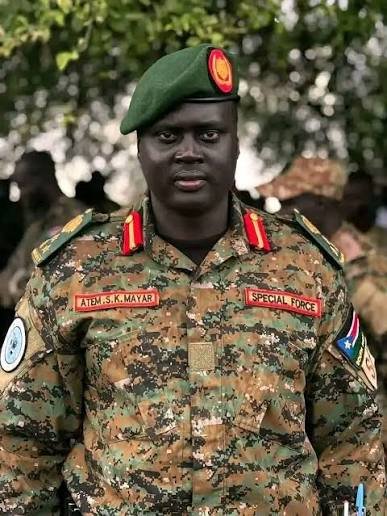

Maj Gen Atem Salva
By Guest Writer – Keletus Valentino Okoye and Joseph Oduha in Munich, Germany
President Salva Kiir’s decision to appoint his son, Maj Gen Atem Salva, as commander of South Sudan’s Presidential Guards Division, popularly known as the Tiger Division, is more than a routine military reshuffle.
It is a political signal. Maj Gen Atem replaces Gen Deng Madhang in charge of one of the country’s most strategically important security formations — the force responsible for protecting the president and other senior government officials. His appointment comes only days after he was promoted within the South Sudan People’s Defence Forces.
For a country emerging from years of civil war and preparing for long-delayed elections, the decision raises an uncomfortable question: what does it mean when the president’s own son is placed in command of the force protecting the presidency? The answer matters not only for President Kiir and his government but for the credibility of South Sudan’s political transition.
Power, family and the state
Since independence in 2011, President Kiir has remained the dominant figure in South Sudanese politics.
Over the years, members of his family have attracted increasing public attention because of their involvement in business, public affairs and positions of influence. The latest appointment brings that family influence directly into one of the most sensitive areas of the state: presidential security.
There is nothing inherently wrong with a president’s relative serving in government or the military if that person is qualified, appointed through a transparent process and held to the same standards as everyone else. The problem begins when public institutions appear to become extensions of political families.
South Sudan has already struggled with perceptions of patronage, nepotism and the concentration of power around the presidency. Appointing the president’s son to command the unit protecting the president inevitably raises questions about whether institutions are being strengthened — or whether personal loyalty is becoming increasingly important to the exercise of state power.
The government should therefore understand why this appointment will attract scrutiny.
Why the Tiger Division matters
The Tiger Division is not an ordinary military unit. Its proximity to the presidency gives its commander an important role in the country’s security architecture. In a political system where disputes between rival leaders have repeatedly translated into armed confrontation, control of presidential security carries considerable political significance.
South Sudan’s history makes this particularly sensitive. The country descended into civil war in 2013 following a political dispute within the ruling Sudan People’s Liberation Movement. Another major conflict followed in 2016 despite the existence of a peace agreement.
The 2018 peace deal brought President Kiir and opposition leader Riek Machar into a power-sharing arrangement, but implementation has been repeatedly delayed. The security sector remains one of the most difficult parts of the peace process.
Against this background, the appointment of the president’s son to command the presidential guards cannot easily be separated from the wider struggle over political and security power.
And then there are the elections
The timing is perhaps the most important part of this story. South Sudan is expected to hold general elections in December 2026 — a vote that has already been delayed several times since the country gained independence. The elections are supposed to mark an important step away from transitional politics and towards a more permanent democratic system.
But elections are not credible simply because citizens are allowed to cast ballots. They require institutions that voters, candidates and political parties can trust. They require security forces that are seen as professional and politically neutral. They require an environment where opposition politicians can campaign without intimidation and where journalists can report freely. And they require the losing side to believe that the institutions overseeing the process are not controlled by the political leadership. This is why the appointment of Maj Gen Atem matters beyond the walls of the presidential compound.
If the commander of the presidential guards is the president’s son, opposition groups and sections of the public may question whether the security architecture surrounding the election is sufficiently independent. Even if those concerns are ultimately unfounded, perceptions matter in an election.
The danger of confusing the state with the presidency
South Sudan’s greatest institutional challenge is perhaps the blurred line between the ruling political establishment and the state itself.
The presidency is a constitutional institution. The army is a national institution. The electoral commission is a national institution. The police and other security agencies are supposed to serve the state rather than an individual or family. When senior positions are repeatedly associated with political loyalty, family connections or personal relationships, those distinctions become harder to maintain.
The danger is not necessarily that every appointee will abuse power. The greater danger is that citizens lose confidence in the institutions themselves. That is particularly dangerous before an election.
Kiir has an opportunity
President Kiir still has an opportunity to demonstrate that the coming elections will be about institutions rather than individuals. That means ensuring that security forces remain politically neutral, that opposition parties are allowed meaningful political space, and that the electoral process is transparent.
It also means explaining important appointments to the public. If Maj Gen Atem’s promotion and appointment are based on professional military qualifications, the government should have no reason to shy away from explaining the decision. South Sudanese citizens deserve to know how senior positions in their national institutions are filled.
The president’s family members are citizens and should not be automatically excluded from public service. But public office comes with a higher burden of transparency, particularly when the office involves control of armed forces.
The real test is bigger than Atem
The debate should therefore not become simply about whether President Kiir has the right to appoint his son. The deeper question is whether South Sudan is building institutions strong enough to survive beyond President Kiir. That is the real test of the country’s transition.
The upcoming elections should not merely determine who occupies the presidential palace. They should test whether South Sudan can begin building a political system in which institutions matter more than individuals, families or military networks.
Maj Gen Atem Salva’s appointment may be perfectly lawful and professionally justified. But in a country preparing for a consequential election, the appearance of concentrated family and security power is itself a political issue.
South Sudan does not only need an election. It needs an election in which citizens believe that the state belongs to them — not to the president, his family or any political faction. That is why the appointment of the president’s son to command the presidential guards deserves serious public debate.