
Friday, 28 August 2026 |Joseph Oduha | Photo: Ministry of Foreign Affairs – South Sudan |
South Sudan has summoned the ambassadors of the United States, Germany, Norway and Japan after the four countries called on the government to take urgent steps to address the country’s political crisis and begin genuine dialogue among rival political parties.
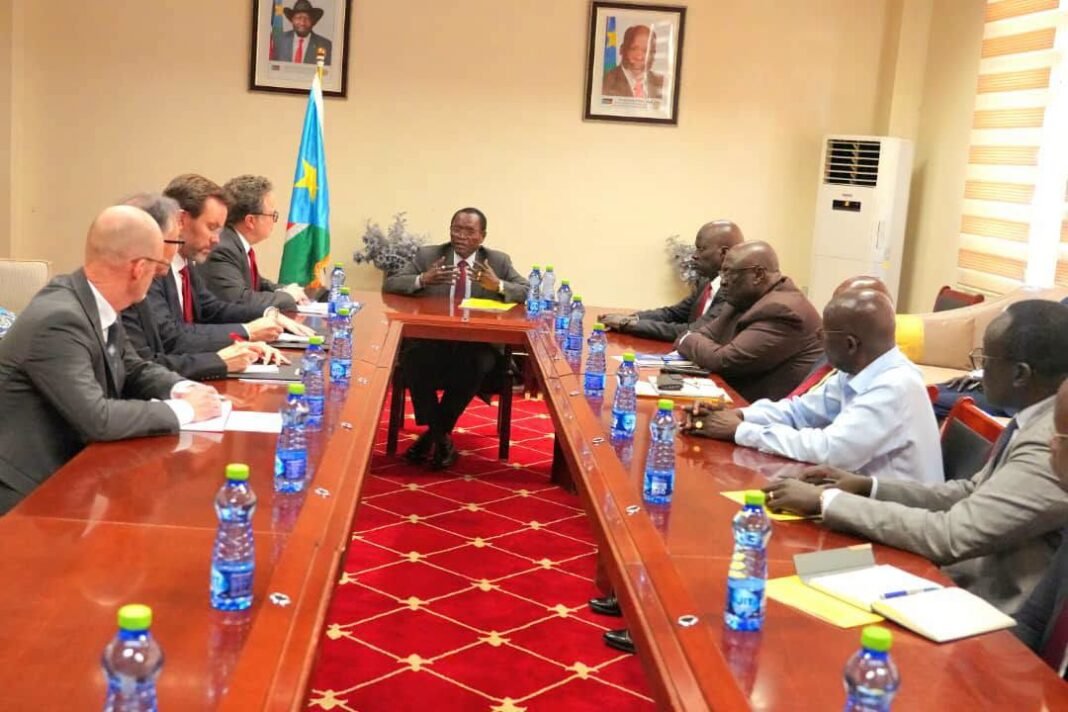
Foreign Affairs and International Cooperation Minister James Pitia Morgan summoned the diplomats and criticized their Aug. 26 joint statement as divisive and inappropriate at a sensitive time, as South Sudan prepares for elections scheduled for December 2026.
The four countries said they shared the South Sudanese people’s hopes for “a future of peace and prosperity” but warned that achieving that goal would require political leaders to take urgent action.
“The path to peace requires urgent action, including the start of authentic interparty dialogue,” the statement said. “The path to peace requires leaders to give up violence as a tool for political competition.”
The countries also called on South Sudan’s leaders to use public money to provide basic services and improve accountability. They said better security and respect for the rule of law would help create an environment where private businesses and investment could grow.
“We are convinced that peace and prosperity can come to South Sudan if the right decisions are made by the country’s leaders,” the statement said.
The South Sudanese government took issue with the message, with Morgan describing it as divisive and arguing that such statements could make an already difficult political situation more complicated.
The summons comes as South Sudan faces growing pressure over its political transition and preparations for elections.
The country has repeatedly delayed key parts of a 2018 peace agreement that ended a five-year civil war between forces loyal to President Salva Kiir and his former deputy, Riek Machar. The agreement was intended to create a power-sharing government and lay the foundation for lasting peace.
Instead, political disagreements and violence have continued, raising concerns about whether South Sudan can hold credible and peaceful elections in December.
The government has maintained that the elections will take place as planned. But opposition groups, civil society organizations and international partners have questioned whether the country has the political, security and institutional conditions needed for a credible vote.
The dispute adds to growing tensions between South Sudan and some of its international partners, who have provided humanitarian and development assistance since the country gained independence in 2011.
A government source, however, said the joint statement was not the only reason the diplomats were summoned.
The source, who asked to remain anonymous and used the name Jok Kueny, said the presidential office was also unhappy that the diplomats met Vice President Rebecca Nyandeng de Mabior in Juba on Aug. 25, one day before the joint statement was released.
Nyandeng had recently criticized the government and called for national dialogue amid rising political tensions.
Kueny said the meeting between U.S. Ambassador Michael J. Adler and other foreign diplomats and Nyandeng was focused on promoting peace and national dialogue.
“Based on the information I have, the recent meeting between U.S. Ambassador Michael J. Adler and other foreign diplomats with Rebecca Nyandeng De Mabior on August 25, 2026, in Juba to push for national dialogue and peace is the reason for this summons,” he said.
Kueny said he did not believe the Aug. 26 statement itself was particularly hostile toward the government.
“If you read the statement, it was not really divisive or biased; rather, it was just a reminder, as ambassadors usually do,” he said.
He also urged the government to listen to criticism from its international partners rather than confront them.
“There should be proper ways of listening to advice from our diplomatic partners, but summoning and threatening them would rather cause more problems than good,” Kueny said.
He also warned against viewing the political crisis through an ethnic lens.
“I am from Warrap State, and the situation should not be looked at from ethnic angle; rather, it should be treated as a national political crisis,” he said.
The Foreign Ministry has not publicly said whether the diplomats’ meeting with Nyandeng was a factor in the decision to summon them.
This political crisis heated up at a critical moment for South Sudan, with less than four months before the government’s planned elections and continued international concern over whether the country can resolve its political disputes without a return to widespread violence.