
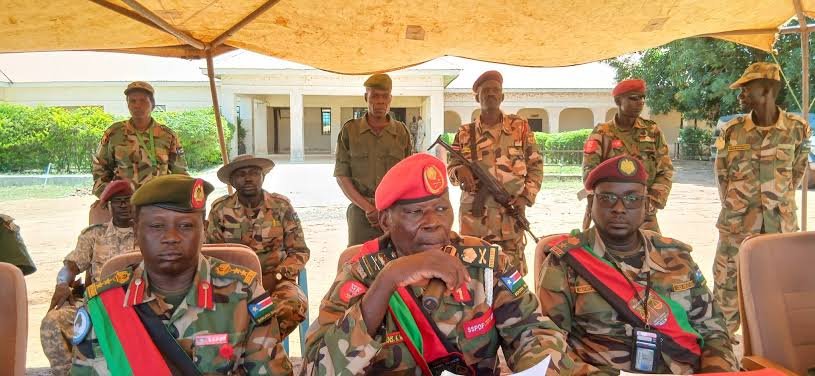

Court-martial judges in Wau | File photo
A South Sudanese soldier has been sentenced to 10 years in prison for abducting and murdering a United Nations staff member in Western Bahr el Ghazal state, the UN Mission in South Sudan (UNMISS) said.
The soldier, who served in the South Sudan People’s Defence Forces (SSPDF), was convicted by a General Court Martial in Wau over the killing of the UN national staff member while he was on official duty in Hai Masna on December 15, 2025.
In addition to the prison sentence, the court ordered the soldier’s demotion, dismissal from the army and payment of compensation of 51 head of cattle to the victim’s family. The ruling allows the accused to appeal.
UNMISS welcomed the judgment, describing it as an important step towards holding people accountable for crimes against UN personnel in South Sudan.
“This judgment is a milestone in efforts to ensure accountability for crimes against United Nations personnel in South Sudan,” said Anita Kiki Gbeho, the UN Special Representative of the Secretary-General and head of UNMISS.
Gbeho expressed sympathy to the victim’s family and thanked them for participating in the court proceedings. She also acknowledged witnesses who testified in the case and praised national authorities for their efforts to pursue justice.
The court martial heard 10 cases and delivered judgments in eight, resulting in four convictions of SSPDF members and four acquittals. Other cases remain under investigation or are being considered for trial, UNMISS said.
The case highlights ongoing concerns about the safety of UN personnel in South Sudan, where peacekeepers and other UN staff have faced deadly attacks while carrying out their duties.
Since UNMISS was established on July 9, 2011, 19 peacekeepers have been killed and 32 others injured in malicious acts, according to the mission.
The UN mission has repeatedly called for accountability for attacks against its personnel, who support peace efforts, protect civilians and assist humanitarian operations across the country.
The latest ruling comes as South Sudan continues to face security challenges and efforts to strengthen accountability within its security institutions.