
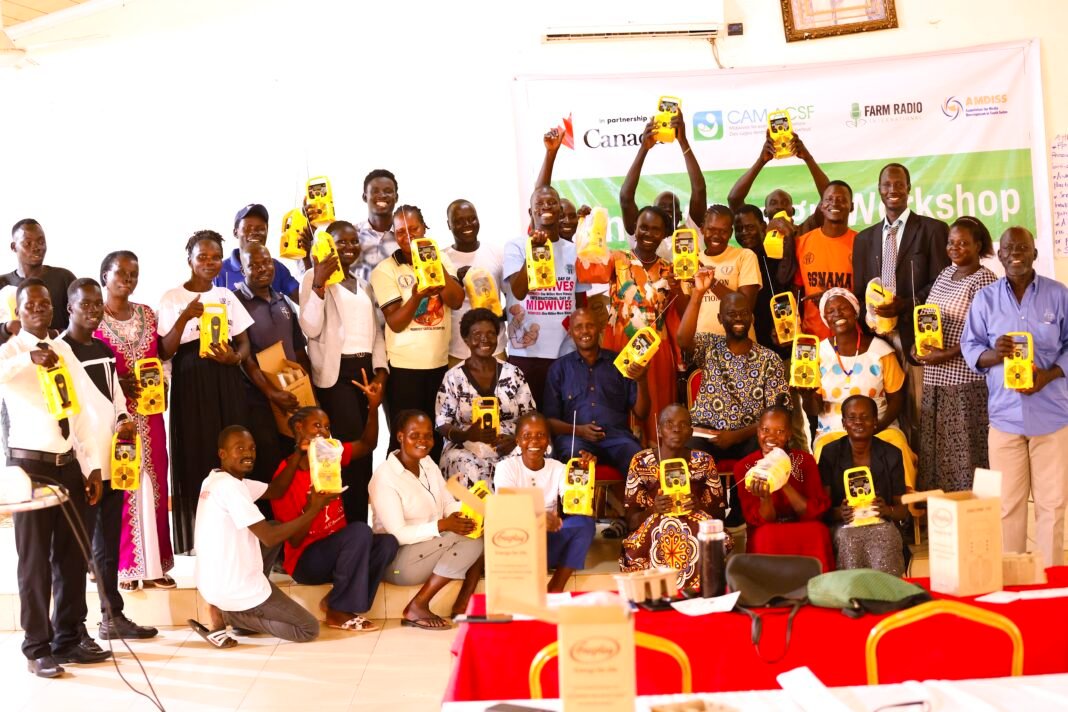

Wednesday, 19 August 2026 |Joseph Oduha | Torit, Eastern Equatoria State | Credit: AMDISS |
Farm Radio International, in partnership with the Association for Media Development in South Sudan (AMDISS), is putting radio listeners at the centre of programme development as part of an effort to improve access to sexual and reproductive health information in Eastern Equatoria State.
The initiative follows a four-day content design workshop in Torit attended by 35 participants from the South Sudan Nurses and Midwives Association, the Ministry of Health, radio stations, media, radio listeners and women-led organisations.
The in-station content design and production sessions began Monday, August 17, at Radio Emmanuel 89.0 FM and will continue through August 20. Radio Emmanuel is an AMDISS member station and part of the Catholic Radio Network.
At least 15 radio episodes on sexual and reproductive health and rights (SRHR) are expected to be produced in Juba Arabic and Otuho. The programmes will be broadcast for one year as the first phase of a five-year project supported by the Canadian Association of Midwives through Global Affairs Canada.
The programmes will be aired in Torit and Bor in Jonglei State, with listeners helping to identify issues and shape the content before it is refined by health professionals and produced by journalists.
Eastern Equatoria State Minister of Information and Communication Elia John Alhaj urged journalists to use the skills gained from the training to improve the quality of their programmes and engagement with listeners.
“How would you inform the public if you’re not informed?” Alhaj asked. “You need to devote your time to learn about the topic before you go to the studio. Some of the listeners are even more knowledgeable about the topic than you.”
Alhaj also called on partners to extend similar support to other radio stations in the state that are not covered by the project.
Clementina Luboya, the director for reproductive health at the state ministry of health, encouraged the journalists to put the skills learned into practice.
“Gaining knowledge is not enough,” Luboya said. “Put the knowledge you gained into practice. Before you enter the studio to present the programme, remember what you have been taught so that when people begin to ask questions, you can give correct answers. If you are not sure about the answer, please don’t give wrong information to the people.”
Radio Emmanuel programme producer Paride Wani Moses said involving listeners in programme production was a new experience for him and his colleagues.
“It is the first time for us to engage our listeners in radio production,” Moses said. “This enables them to own the content once the productions are done.”
He said the approach allows ideas to come from listeners, be refined by nurses and midwives, guided by journalists and overseen by the state government.
“The ideas were generated from the listeners, refined by midwives and nurses, guided by the media, and overseen by the state government,” Moses said. “This is a unique cycle of programme production I have never attended before in my journalism career.”
Moses called for computers and digital recorders to support production, saying some of the station’s equipment is outdated and slows down programme production.
Juma Peter Maya, AMDISS advocacy and communication manager, said the programmes would help communities better understand SRHR and counter myths and misinformation about reproductive health.
He said health workers, government officials and community leaders would take part in radio discussions on adolescent reproductive health, family planning and birth spacing.
Ayella Benson, a child protection officer and social worker with the State Ministry of Gender, Child and Social Welfare, urged the partners to establish a toll-free number to make it easier for listeners to participate in live programmes.
“Most listeners may not have telephone credit to call the radio during the programme,” Benson said.
Benson also welcomed the provision of solar-powered radio sets, saying they would help communities follow programmes without relying on mobile phones.
Farm Radio International and AMDISS are implementing the project in Torit and Bor with support from the Canadian Association of Midwives through Global Affairs Canada. The initiative aims to strengthen community participation in radio programming and expand access to reliable SRHR information.