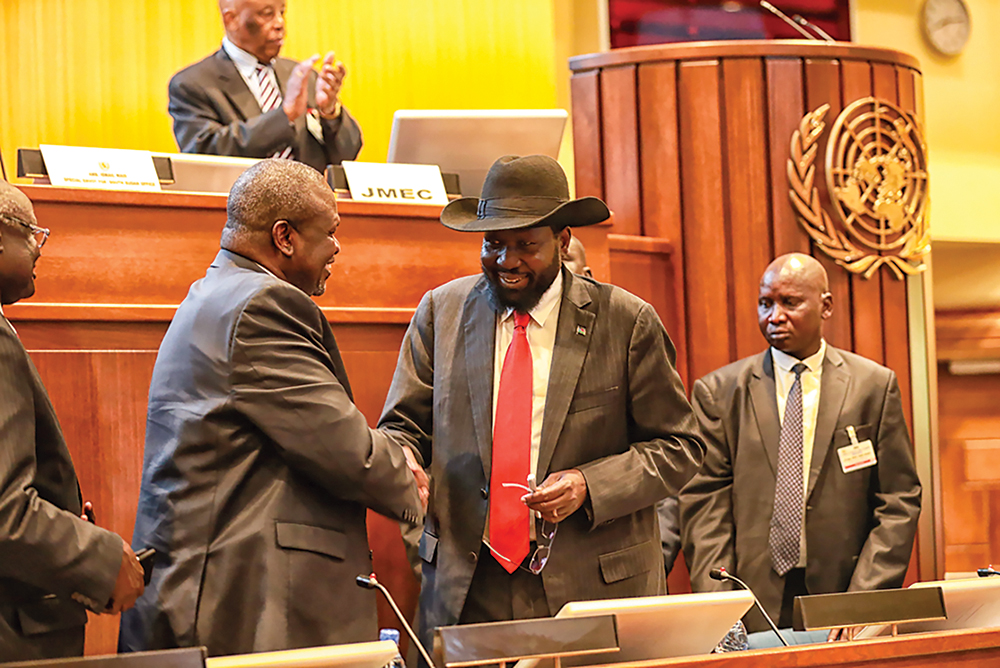

President Salva Kiir and his rival Riek Machar
Tuesday, 16 June 2026 | Author: Andrew Michael | File Photo | GT-News |
JUBA, South Sudan—Prominent South Sudanese academic and author Jok Madut Jok has delivered a scathing assessment of the country’s governance and accountability systems, arguing that key institutions responsible for overseeing public finances have become ineffective and unable to hold the executive accountable.
In a public commentary, Jok said South Sudan’s financial management and oversight mechanisms were “essentially dead,” accusing the legislature, the National Audit Chamber, and the Anti-Corruption Commission of failing to perform their constitutional mandates.
“The supreme body in the land, the legislature, is dead, and cannot hold the executive to account for its financial misdeeds,” Jok said, alleging that the Office of the President routinely exceeds its allocated budget without facing scrutiny from oversight institutions.
He argued that members of parliament and officials in accountability institutions have been weakened through political pressure, intimidation, and co-option, leaving them unable or unwilling to challenge government spending practices.
Jok also criticized the National Audit Chamber, saying audit reports highlighting financial misconduct have repeatedly failed to reach parliament for consideration.
“The Audit Chamber has produced accounts showing misconduct year after year, but the reports never make it to the Transitional National Legislative Assembly,” he said.
The academic further claimed that the Anti-Corruption Commission has been deprived of the resources and authority needed to investigate corruption allegations effectively, describing it as an institution that has been rendered powerless.
According to Jok, the country faces a critical choice between a national dialogue on governance failures and increased civic action by citizens demanding accountability.
“The only way out is either we all sit down and discuss what has gone wrong with this country or a people’s civic action is overdue,” he said.
Veteran journalist and political commentator Jacob Jiel Akol echoed concerns about the state of public financial oversight, questioning the independence of the Auditor General’s office and calling for stronger public financial management systems.
Akol described Auditor General Stephen Wundu as a capable professional but argued that his position within the ruling Sudan People’s Liberation Movement (SPLM) raises questions about institutional independence.
“Stephen Wundu is indeed brilliant, but he is an SPLM insider, not an independent auditor,” Akol said.
He noted that audit reports exposing budget overruns, particularly within the Presidency, were initially presented publicly but later failed to reach parliament after generating political embarrassment.
Akol contrasted Wundu’s tenure with that of former Auditor General Barnabas Majok, whom he described as one of the first relatively independent auditors in South Sudan. According to Akol, Majok’s efforts to reform the institution were cut short by political resistance.
The comments by Jok and Akol come amid longstanding concerns from civil society groups, international financial institutions, and governance advocates about transparency, public spending, and anti-corruption efforts in South Sudan.
Successive audit reports have highlighted weaknesses in financial controls and accountability mechanisms, while critics argue that oversight institutions lack the independence and resources necessary to ensure proper management of public funds.
The government has previously stated its commitment to strengthening governance reforms and improving public financial management, though concerns over implementation persist.