
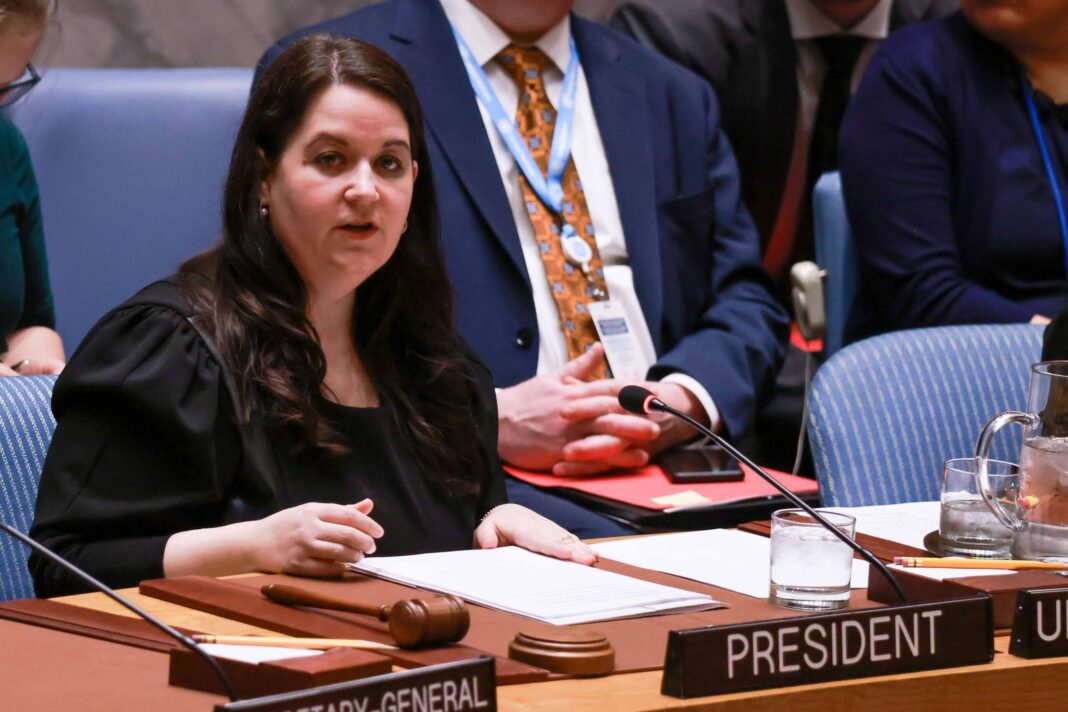

Friday, April 17, 2026 | Author – Alex Onyango | Nairobi-Kenya | Photo: US Mission to UN | GT-News |
United Nations, April 16 – The United States on Thursday issued a blistering ultimatum to the UN Security Council, warning that it will no longer support the “habitual” renewal of failing peacekeeping missions that have drifted into multibillion-dollar “open-ended commitments.”
In a sharp-tongued address, U.S. Alternative Representative for Special Political Affairs Jennifer Locetta threatened to pull the plug on the 15-year-old mission in the disputed Abyei region if Sudan and South Sudan do not show immediate progress.
“Survival should not be our threshold for success,” Locetta told the Council. “When conditions change, peacekeeping missions need to adapt or close.”
‘Gaming the System’
The U.S. intervention highlights a growing frustration in Washington over the soaring costs and diminishing returns of UN blue-helmet deployments. Locetta argued that host governments have learned to “game the system,” using the UN’s presence as a security shield while actively undermining its work through “deliberate acts of obstruction.”
She singled out the UN Interim Security Force for Abyei (UNISFA) as a prime example of a “temporary” tool gone wrong. Despite 15 years on the ground and billions in taxpayer funding, Locetta noted there has been “virtually no progress” on delineating the border or demilitarizing the area.
“Consent cannot become a shield for inaction,” Locetta warned, accusing Khartoum and Juba of “strangling” the mission by denying visas and blocking key civilian appointments. “Renewal must be earned—never assumed.”
A Model for Exit?
While the speech was largely a critique of the status quo, the U.S. pointed to the mission in the Central African Republic (MINUSCA) as a rare success story in strategic “repositioning.”
Following successful elections in the CAR, MINUSCA has begun drawing down its footprint in stable areas like the capital, Bangui, handing over control to national police. The U.S. is pushing for this “exit-focused” model to be codified across the entire UN peacekeeping enterprise.
Financial Pressure
The timing of the speech is significant, coming as the U.S. continues to scrutinize its contributions to the UN’s massive peacekeeping budget. By framing the issue as one of “taxpayer funding” and “risk to lives,” the Biden administration is signaling that its patience for diplomatic inertia has reached a breaking point.
“We simply cannot continue to call for ‘adaptive peacekeeping’ while opting for the status quo out of sheer habit,” Locetta concluded.
The Security Council must now weigh whether to call the bluff of the mission’s host nations or risk a U.S. veto on future mandate extensions—a move that could leave thousands of civilians in volatile border regions without international protection.