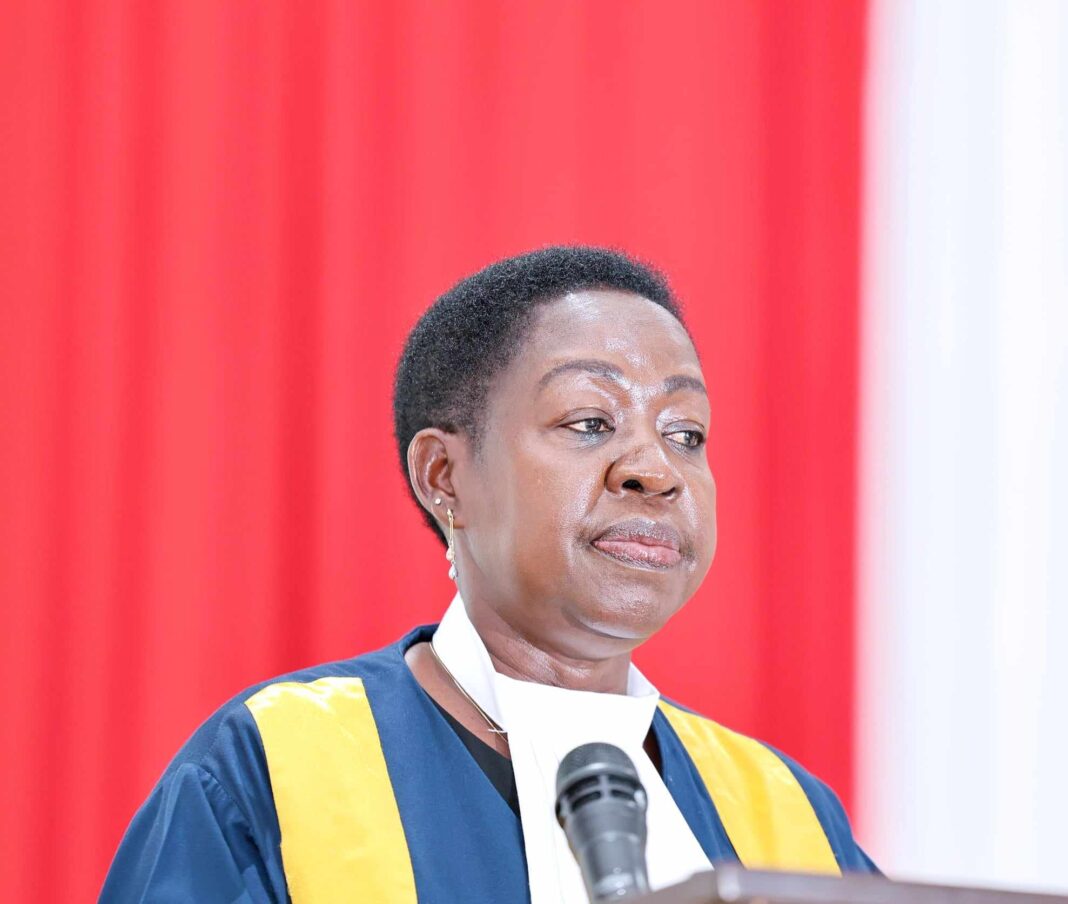

Speaker Jemma Nunu Kumba addresses the lawmakers after recess—Courtesy: Office of the President.
Speaker of South Sudan’s Transitional National Legislative Assembly, Hon. Jemma Nunu Kumba begged the international community to lift the sanctions and arms embargo imposed on her country amid the hyperinflation despair eroding the value of the local currency as the market prices shoot higher marking record.
Addressing the parliamentarians during the inauguration of the first session of the Transitional National Legislative Assembly, Speaker Nunu struck a hopeful note that, the government would address the economic challenges to improve the living conditions of its citizens.
Early last week, the Minister of Finance and Planning Awou Daniel Chuang disclosed that the government was looking for a loan from international financial institutions to pay off one month’s salary for the civil servants and the organized forces.
The civil servants and army were last paid in July last year. The former Finance Minister Agak Achuil Lual said South Sudan’s crude oil has been sold in advance for the next five years making the country survive on loans from the African Development Bank and China Exim Bank which charge high interest rates for every single dollar lent.
“Where am I going to get the money? If the oil has been sold in advance up to 2027 that means I will go to 2028 to ask somebody to give me money such that by 2028 he will be given that oil,” the minister explained. “And by the time I am gone, somebody will come in my place and he will find out that all oil of 2028 has been sold so he will have to go for 2029,” Minister Agak disclosed this to the media during the press conference in Juba, a revelation that triggered his sacking by the president in late 2022.
The Iran-backed Houthis’ blockade in the Red Sea and subsequent conflict in Sudan as well as the petroleum jellying difficulty preventing crude oil from passing through the pipeline, make it nearly impossible for South Sudan to send off its oil shipments to the international market for sales.
The leading East African oil-producing country—South Sudan—is solely dependent on oil proceeds to finance its government operations and payment of the salaries of civil servants, the army, and other regular forces. The local currency [South Sudanese Pound] continues to lose value against the US dollar at unprecedently margins.
South Sudan imports food and non-food items imports from neighboring Uganda and Kenya spiralling the demand for hard currency to access the goods in the regional trade market.
The country’s president, Salva Kiir Mayardit, ordered urgent diversification of the sources of revenue and an increase in local food production to alleviate the suffering of the civil population while urging his political opponents to embrace the democratic way of solving issues and shun political violence in all forms to maintain nation-wide stability.
“Our economy has been affected by global challenges, although the government increased salaries by 400%, still our dependence on oil and depreciation of our currency has affected the economy,” Kiir said.
“This demands urgent intervention like diversifying the revenues and increasing local production. Thus, the government will secure the supply of fuel and basic commodities,” he pledged.
President Kiir also directed the Ministry of Agriculture and Food Security to revive old agricultural schemes across the country to boost food production.
He assured the nation that his government has installed the Air Traffic Control System, saying the country will soon take over the control of its airspace, which will allow the registration of airlines and collection of taxes.
The United States government and the UN Security Council imposed sanctions and an arms embargo on South Sudan limiting the country’s access to financial flow and purchase of arms to equip the South Sudan People’s Defence Force and other regular forces.
The sanctions target some senior government officials over their alleged subversive role in spoiling the peace efforts in the country.