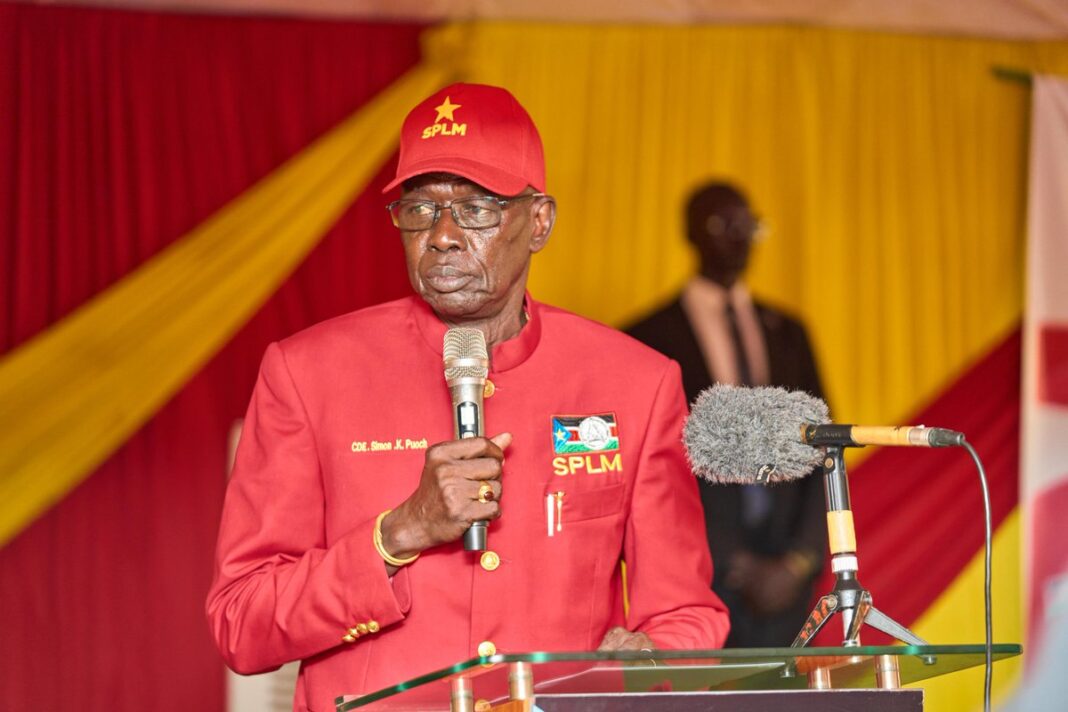

Simon Kun Puoch
Thursday, 14 May 2026 | Author: Andrew Michael | File Photo| GT-News |
A senior official in South Sudan’s ruling Sudan People’s Liberation Movement (SPLM) has threatened to abandon the country’s fragile peace agreement and accused Western powers of interfering in domestic affairs.
Simon Kun Puoch, the SPLM’s third deputy chairman, made the remarks during a gathering of party supporters in the capital, Juba, where he criticised the 2018 revitalised peace agreement that ended years of civil war.
“I, as Simon Kun, don’t believe in the revitalised peace agreement, because the SPLM is not in it,” Kun said in a statement extended to this outlet.
He said he had told the US and British ambassadors that the SPLM could “disown” the agreement, arguing that countries grouped under the Troika — the United States, Britain and Norway — were not signatories to the deal and should not influence South Sudan’s political process.
“Why are they coming here to dictate to us in this country?” Kun asked.
The peace agreement created a unity government between President Salva Kiir’s SPLM and rival groups led by First Vice President Riek Machar and other opposition factions after a five-year conflict that killed hundreds of thousands of people and displaced millions.
The accord has repeatedly faced delays and implementation challenges, including disagreements over security arrangements, constitution-making and preparations for elections.
South Sudan’s transitional government has pledged to hold elections at the end of the current transition period, though critics and observers have questioned whether conditions for credible polls are in place.
Kun insisted the SPLM remained committed to elections and rejected what he described as external pressure from regional and international actors, including the Intergovernmental Authority on Development (IGAD), the East African bloc that mediated the peace process.
“The SPLM is telling us that we have to go for elections,” he said.
The Troika countries and regional mediators have repeatedly urged South Sudan’s leaders to fully implement the peace agreement and avoid actions that could undermine stability.
The United States imposed visa restrictions on members of South Sudan’s transitional government, accusing them of obstructing the peace process, fuelling corruption and contributing to violence that threatens to plunge the country back into war.
In a statement, the US Secretary of State Marco Rubio said the measures targeted officials believed to have undermined the 2018 peace agreement.
Washington said South Sudan’s transitional government had “for years” delayed implementation of the Revitalised Agreement on the Resolution of the Conflict in South Sudan (R-ARCSS), leaving the country “on the brink of a return to all-out war”.
The US did not immediately publish the names of those affected by the visa restrictions.
The statement also accused senior officials and business entities of corruption, alleging that state funds and foreign aid intended for ordinary South Sudanese had been diverted.
Among the entities named was Crawford Capital Ltd., which the US linked to alleged financial misconduct.
Washington further accused the South Sudan People’s Defence Forces (SSPDF), loyal to President Kiir, of carrying out a military offensive in northern Jonglei State that displaced about 300,000 people and increased the risk of famine in parts of the country.
It also cited what it described as credible reports of human rights abuses and ethnically targeted killings against members of the Nuer community.
South Sudan, the world’s youngest nation, gained independence from Sudan in 2011 but descended into civil war two years later following a political dispute between Kiir and Machar.
The conflict killed hundreds of thousands of people and displaced millions before a peace deal was signed in 2018.
However, key parts of the agreement — including security reforms, the drafting of a permanent constitution and preparations for long-delayed elections — have repeatedly stalled.
Tensions have risen in recent months amid renewed clashes in some areas and growing concern among regional and international observers about the future of the fragile unity government.
“The United States will continue to stand with the South Sudanese people, who want to live in peace and dignity,” Rubio said, adding that Washington would continue pursuing accountability measures against individuals accused of threatening peace and stability in the country.