
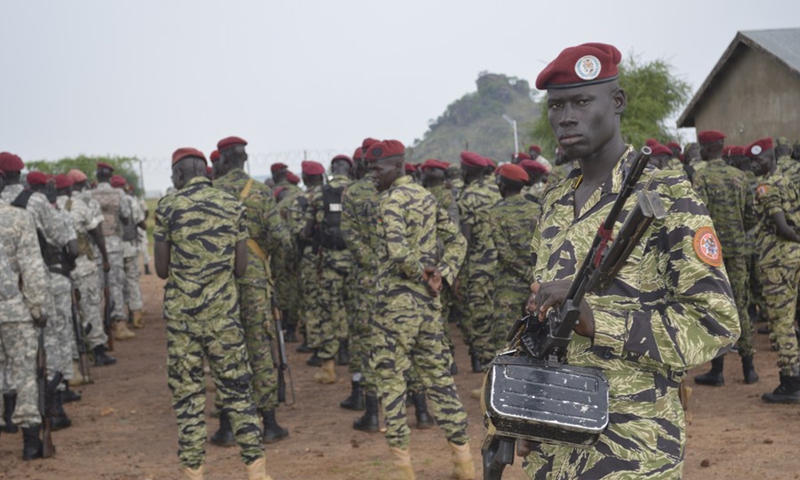

South Sudan People’s Defense Forces
Monday, 11 May 2026 | Author – Hafed AlGhwell | Photo: Xinhua | GT-News |
South Sudan is nearing a phase more dangerous than the civil war that ended in 2018. Earlier violence revolved around elite competition in Juba; now instability spreads from the collapse of the state’s economic core and inward from a regional conflict system stretching across Sudan, Chad, Libya, the Central Africa Republic, Ethiopia, and the Red Sea corridor.
The pressure is not from a single front. Oil revenues have collapsed, state salaries have evaporated, and armed groups finance themselves through looting, cattle raiding, checkpoints, and remittances. Local militias increasingly ignore leaders who once exercised authority over them.
In effect, South Sudan’s crises resemble tectonic stress accumulation. “Small” shocks traveling rapidly across oil infrastructure, ethnic mobilization, border militarization, humanitarian collapse, and succession struggles are making a wider rupture visible.
Economic collapse is at the heart of South Sudan’s maladies.
Oil accounts for roughly 90 percent of state revenues and nearly all foreign exchange. Pipeline disruptions linked to Sudan’s war hit Juba like a financial airstrike, cutting revenues by over 70 percent and shredding the patronage system that tied commanders, governors, militias, and civil servants to the center. Now, security forces and civil servants have reportedly gone unpaid for seven to 11 months.
In a country where salaried employment sustains entire extended families, it triggers cascading effects: reduced food access, collapsed local markets, rising armed recruitment, and intensified communal raiding. At the same time, currency depreciation and inflation have rendered imported fuel, medicine, and food unaffordable, corroding the social fabric. Unpaid soldiers now subsist on extraction, and government offensives in Upper Nile and Jonglei resemble mobile resource raids, confiscating cattle, grain, and river commerce.
Juba’s response to fiscal collapse has worsened the long-term outlook.
A reported $13 billion financing arrangement linked to UAE-based HBK DOP securitizes future oil production over nearly two decades, with minimal parliamentary scrutiny. Terms remain opaque, and revenue streams are being pledged before production stability exists.
Such oil-backed debt cycles have repeatedly transformed oil ministries into repayment agencies for external creditors. Angola experienced similar oil-backed debt cycles during earlier commodity booms, while Congo-Brazzaville and Chad repeatedly mortgaged future production against immediate liquidity needs. South Sudan risks the same fate.
Economic deterioration would be dangerous in isolation, but regional militarization has made the situation combustible. A contiguous instability corridor now runs from southern Libya through Chad and Darfur into South Sudan and the Horn. Arms, fighters, fuel, gold, and smuggled capital move through networks blending insurgency, commerce, and statecraft. Libya’s “Kufra corridor,“ for instance, channels weapons via Chad and Darfur, fusing militia economies and intelligence services.
Meanwhile, Russian-linked Africa Corps networks accelerate militarization along the Sudan-Central Africa Republic-South Sudan border, where gold extraction and proxy relationships create hybrid security-commercial systems that spread violence across nominal borders.
South Sudan’s own geography favors fragmentation.
Marshlands, floodplains, and porous frontiers defy centralized control. Large parts of Upper Nile and Jonglei already function through negotiated local authority, and under stress, commanders, cattle guards and ethnic militias eclipse ministries.
Sudan’s war further amplifies the pressure in South Sudan, even though Juba officially maintains neutrality. Neither the Rapid Support Forces nor the Sudanese army believes it; the army suspects Juba of permitting RSF logistical movement, while South Sudanese opposition groups search for external sponsors.
“Local militias increasingly ignore leaders who once exercised authority over them,” Hafed Al-Ghwell.
Worse yet, Juba’s political leadership is poorly positioned to manage such a complex environment. President Salva Kiir Mayardit governs through delay, fragmentation management, and selective coercion, making credible December 2026 elections improbable: A census is absent, constitutional reform stalled, security-sector integration incomplete, and large sections of the opposition distrust electoral mechanisms. Political postponement serves as both survival strategy and destabilizing force.
Recent purges, vice presidential rearrangements, and reliance on family networks signal intensifying succession anxiety inside the ruling coalition. First Vice President Riek Machar’s authority has crumbled under house arrest and treason proceedings, accelerating command fragmentation. Younger commanders view the Sudan People’s Liberation Movement-in-Opposition leadership as detached, and power drifts toward localized armed entrepreneurs.
Gen. Simon Gatwech Dual’s Kit-Gwang faction, which quit peace structures and declared renewed hostilities, typifies commanders who see negotiated settlements as enriching elites while abandoning fighters. Gen. Johnson Olony, nominally state-aligned but functionally autonomous, embodies normalized punitive violence.
But the most consequential shift may be the rise of Makuach Tut. His mobilization capacity reportedly numbers several thousand fighters, rooted in spiritual legitimacy outside party structures. Young fighters trust spiritual leaders embedded in community survival systems over politicians. Tut’s movements toward Malakal generated alarm; his followers appear motivated by defense, revenge, cattle recovery, and resource access.
Such formations are neither fully political nor criminal, eluding Western peacemaking frameworks that assume centralized command. The White Army, for instance, operates through diffuse consensus and sectional mobilization. Violence thus becomes self-replicating: Aerial bombardment triggers self-defense mobilization, leading to retaliatory raids, intensified ethnic fear and further recruitment, weakening central authority.
Regional mediation has failed to adapt to this evolving context.
The Kenya-led Tumaini Initiative briefly offered an alternative engagement channel but lost momentum; Juba saw it as a threat to electoral timelines, and opposition factions rejected it without security-sector reform and rollback of repressive laws.
Regional actors also lack coherence. The Intergovernmental Authority on Development struggles to project authority because Ethiopia, Kenya, Uganda, and Sudan are all consumed by domestic or bilateral pressures.
Elsewhere, international policy remains trapped in outdated assumptions, fixated on elections despite conditions incompatible with meaningful voting. Funding ballots without addressing armed fragmentation and state insolvency would legitimize institutional collapse.
Humanitarian indicators point to systemic failure with millions requiring assistance, especially refugees and internally displaced persons who, together, number almost half the population. Flooding, food insecurity, and aid reductions compound the emergency. Neighboring states have limited absorption capacity — Sudan at war, Ethiopia volatile, Uganda strained — making secondary migration toward Libya and the Mediterranean increasingly likely.
December 2026 is, therefore, less a democratic milestone than a possible ignition point. Spoiler factions have little incentive to trust electoral outcomes. Armed groups excluded from resource access may see disruption as rational, while elite factions in Juba remain divided over succession. Given the economic collapse, buying loyalty becomes infeasible.
Preventing wider war requires abandoning comforting illusions. Elections alone will not stabilize South Sudan. Elite bargains no longer control violence, and humanitarian aid cannot substitute for state functionality. At the same time, security-sector reform on paper means nothing while soldiers survive through looting.
South Sudan is no longer merely a fragile post-conflict republic; it is the convergence point of a broader regional fracture system. Economic collapse, proxy warfare, militia autonomy, and political exhaustion are simultaneously coalescing.
Tremors are already moving beneath the surface. The quake itself may still be avoidable.
Hafed Al-Ghwell is senior fellow and program director at the Stimson Center in Washington and senior fellow at the Center for Conflict and Humanitarian Studies.
Source: Arab News X: @HafedAlGhwell
Disclaimer: Views expressed by writers in this section are their own and do not necessarily reflect Arab News’ point of view