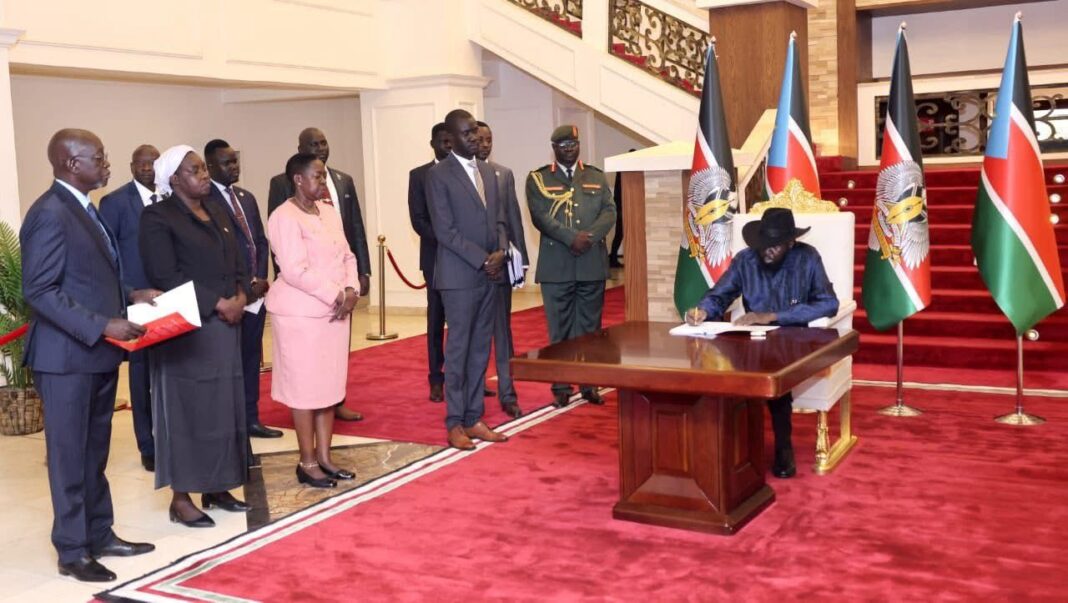

President Salva Kiir is seen signing the Cybercrimes and Computer Misuse Law.
Friday, April 17, 2026 | Author – Alex Onyango | Nairobi-Kenya | Photo: PPU-South Sudan | GT-News |
A newly enacted cybercrime law in South Sudan is drawing sharp criticism from press freedom advocates, who warn it could be used to silence journalists and criminalise legitimate online speech.
The Committee to Protect Journalists (CPJ) has called on authorities in Juba to urgently review the Cybercrimes and Computer Misuse Act, 2026, arguing that several of its provisions are vague, overly broad, and open to abuse.
The law, signed by President Salva Kiir in February, introduces penalties of up to five years in prison for defamation and publishing “false or misleading” information—a move critics say contradicts international human rights standards.
“In its current form, the Act presents a risk of potential misuse and self-censorship,” said James Bidal, a South Sudanese human rights activist and head of the South Sudan Human Rights Defenders Network.
Vague language, sweeping powers
Central to the concern are provisions that criminalise undefined categories such as “undesirable content” and “false or misleading information.” Critics argue these terms could be interpreted subjectively, leaving journalists and citizens vulnerable to prosecution.
The law also grants significant powers to the National Communication Authority, including the ability to access “any” user data deemed necessary—without judicial oversight.
Other provisions raise alarm:
- Publishing information that causes “public panic” or harms reputations could lead to five years in jail
- Platform administrators may face prison for failing to remove vaguely defined unlawful content
- “Offensive communication” and “cyber harassment” carry criminal penalties, with broad definitions
- “Cyberbullying” offences could result in sentences of up to 10 years imprisonment
Regional trend reversed
The legislation stands in contrast to a growing trend across Africa, where countries including Kenya, Ghana, Sierra Leone, and South Africa have moved to abolish criminal defamation laws.
International bodies such as the United Nations and the African Commission on Human and Peoples’ Rights have long advocated for decriminalising defamation, arguing that imprisonment for reputational harm violates freedom of expression.
“South Sudan’s 2026 cybercrimes law is fundamentally flawed,” said CPJ Africa Programme Coordinator Muthoki Mumo.
“Authorities need to go back to the drawing board to tackle cybercrime without undermining press freedom.”
A hostile climate for journalists
South Sudan already has one of the most challenging environments for journalists in the region. Since gaining independence in 2011, media workers have faced censorship, arbitrary detention, and intimidation.
According to CPJ, at least 10 journalists have been killed since 2012.
In 2025, authorities temporarily suspended social media access and blocked an online news outlet, further raising concerns about shrinking civic space.
With the new law in place, critics fear the risks to journalists—and ordinary citizens—could deepen.
Government officials say the legislation is aimed at tackling online fraud and digital abuse, but have yet to publicly respond to the growing backlash.