
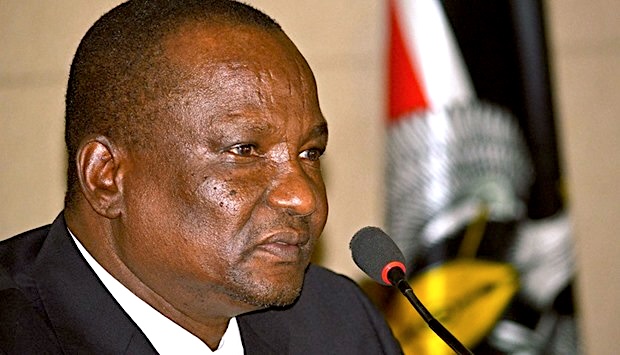

Vice President Taban Deng Gai
Tuesday, 24 March 2026 | Author – Alex Onyango | Nairobi-Kenya |File Photo| GT-News |
A rare and striking admission from within South Sudan’s top leadership has exposed apparent cracks at the highest level of government, with Vice President Gen. Taban Deng Gai revealing he has been unable to meet President Salva Kiir for nearly a year.
Speaking emotionally during funeral prayers in Juba for victims of the deadly Abiemnhom massacre, Taban said repeated attempts to see the president have been blocked by officials inside the Office of the President.
“It is difficult to believe that a vice president cannot meet the president. Who can believe? You will not believe it,” he told mourners.
Taban, one of five vice presidents in the coalition government of South Sudan, formed under the 2018 revitalised peace agreement, said his last meeting with President Kiir was in May last year after returning from Unity State. Since then, he claims, access to the president has been effectively cut off.
He went further, alleging that letters addressed to President Kiir are sometimes withheld and that even his requests to travel to his home area in Unity State since Christmas have gone unanswered.
The unusually candid remarks came as the country reels from the March 1 attack on Abiemnhom County in the Ruweng Administrative Area, where at least 213 people — including soldiers — were killed in one of the deadliest incidents in recent months.
Taban suggested the tragedy could have been prevented.
“They knew there was an attack coming. What were they doing?” he asked, criticizing authorities in both Unity State and Ruweng Administrative Area for failing to act on prior intelligence.
He said a criminal case has been opened and insisted the massacre should not be framed as tribal violence, but as a matter of law enforcement, adding that the perpetrators are known.
The vice president also pointed to deeper governance challenges, including bureaucratic bottlenecks, roadblocks and restrictions on movement that he says are undermining leaders’ ability to respond to crises.
“Leaders don’t talk to their people,” he said. “There is someone who cannot travel without securing permission. If I have not been granted approval by the president, I cannot go.”
Taban disclosed that he and other senior officials, including Vice President Hussein Abdelbagi and presidential security adviser Tut Gatluak, are planning to seek a meeting with Kiir upon his return from South Africa to address escalating violence.
He also used the moment to back growing calls for accountability, including confronting corruption within the presidency itself.
His remarks — delivered in a public and solemn setting — are likely to raise fresh questions about coordination, access and decision-making at the heart of South Sudan’s fragile unity government.
Taban Deng split from the SPLM/A-IO with senior military and political leaders, amid the deadly state-house conflict that resulted in thousands of deaths in Juba and other parts of South Sudan.
He announced his intention to join the SPLM mainstream led by President Kiir, but has faced rejection and has not been integrated into the ruling party. President Kiir expressed concerns and requested a formal written allegiance, which Taban hesitated to provide.