
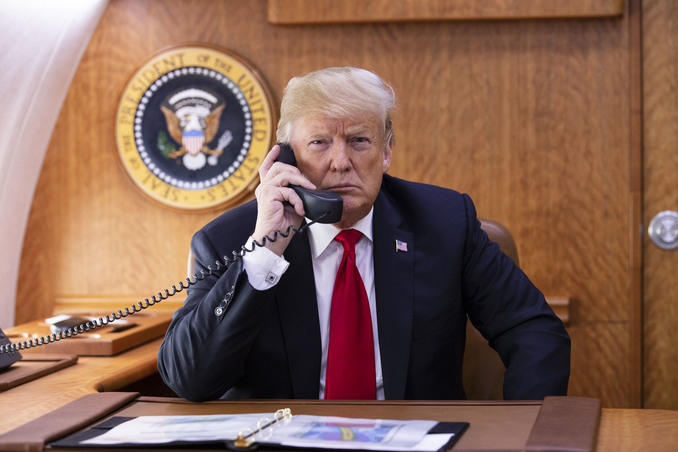

Wednesday, 8 April 2026 | Author – Alex Onyango | Nairobi-Kenya | Photo Credit: whitehouse.gov| GT-News |
Nairobi, April 8, 2026 (The Golden Times) — The United States and Iran agreed to a fragile two-week ceasefire late Tuesday, stepping back from the brink of major military escalation after last-minute mediation by Pakistan.
The breakthrough came just hours before President Donald Trump’s deadline to launch sweeping strikes on Iranian infrastructure, in what would have marked a dramatic escalation of the five-week conflict.
Under the deal, Iran will allow the temporary reopening of the Strait of Hormuz — a critical artery for global oil supplies — in exchange for a suspension of US military action.
“Subject to Iran agreeing to the complete and safe opening of the Strait of Hormuz, I will suspend the bombing for two weeks,” Trump said, hailing the move as “a big day for world peace.”
Pakistan’s Prime Minister Shehbaz Sharif, who led the diplomatic push, said the pause aims to “allow diplomacy to run its course,” with talks expected in Islamabad in the coming days.
Iran’s Foreign Minister Abbas Araghchi confirmed Tehran’s acceptance, saying coordinated measures would ensure safe navigation through the strait during the ceasefire period.
Last-minute reversal
The agreement followed hours of heightened tension, with US bombers reportedly already airborne and Trump warning earlier that “a whole civilization will die tonight” without a breakthrough.
Despite the announcement, uncertainty lingered over the scope of the deal. Israel said it backed the ceasefire with Iran but stressed it would continue operations against Hezbollah in Lebanon.
Confusion also surrounded Iran’s proposed negotiation framework, with discrepancies emerging between different versions of a 10-point plan — particularly over uranium enrichment.
Markets rally, risks remain
Global markets reacted quickly, with oil prices falling and stocks rising on expectations that energy flows through Hormuz — which handles roughly a fifth of the world’s oil — could resume.
But the situation on the ground remained volatile. Strikes were reported shortly before the ceasefire took effect, highlighting the fragility of the truce.
International reactions were cautious. Germany called the agreement a “crucial first step,” while Iraq urged deeper dialogue to address the roots of the conflict.
Energy-dependent nations including Japan and South Korea welcomed the move, though officials warned it was too early to assume lasting stability.
The ceasefire opens a narrow window for negotiations after weeks of fighting, but with key issues unresolved, the risk of renewed escalation remains high.