
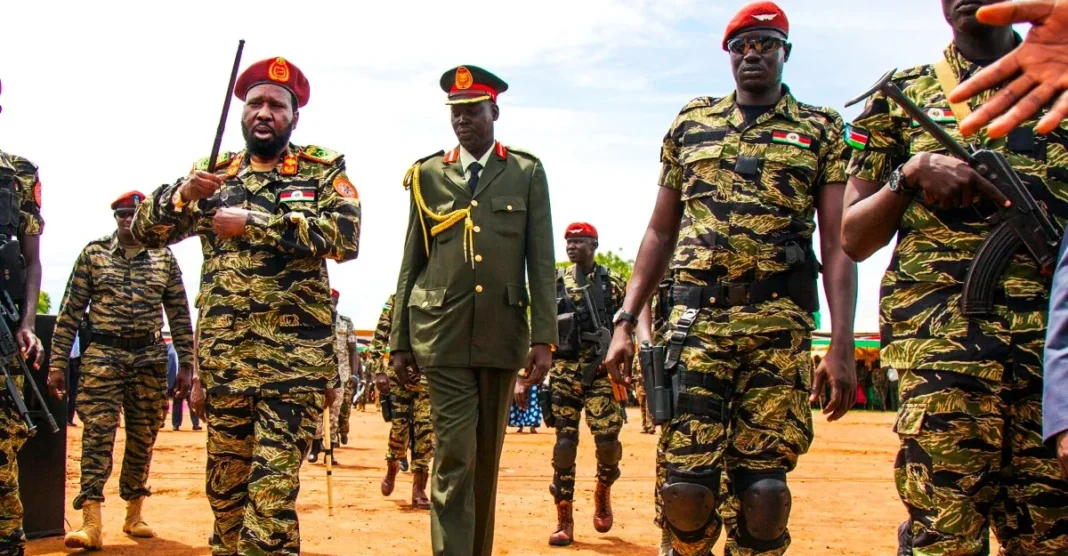

South Sudan President Salva Kiir Mayardit is guarded by the Tiger Forces
Wednesday, 18 March 2026 | Author – Alex Onyango | Nairobi-Kenya |Photo: File Photo| GT-News |
South Sudan’s government has defended ongoing military operations across parts of the country, saying they are necessary to restore stability, while reaffirming its commitment to dialogue and the implementation of the 2018 revitalized peace agreement.
In a statement issued on Wednesday, the government said it shares concerns raised by the South Sudan Council of Churches (SSCC) over the country’s political, security, and humanitarian situation, but stressed that it has a constitutional duty to maintain law and order.
It said recent operations, including in Jonglei State, were carried out in response to attacks by armed groups and were aimed at protecting civilians.
According to the government, between December 2025 and January 2026, a splinter faction of the Sudan People’s Liberation Movement/Army in Opposition (SPLM/A-IO) led by Nathaniel Oyet Pierino, together with allied White Army fighters, launched attacks on South Sudan People’s Defense Forces (SSPDF) positions in Waat and Pajut and threatened to march on Juba.
It added that similar incidents were reported in parts of Central and Western Equatoria as well as in the Ruweng Administrative Area.
“The government did not initiate these hostilities,” the statement said, calling on all armed groups to cease violence and prioritize dialogue to ease civilian suffering.
The government also condemned attacks against civilians and acknowledged concerns raised by church leaders about the impact of violence on vulnerable groups, including women, children and the elderly. It said those responsible for crimes against civilians would be held accountable under the law.
On political engagement, the government said dialogue remains a key pathway to lasting peace, citing a December 2025 meeting of political parties that resolved to hold structured discussions on elections and post-election arrangements under the peace agreement.
However, it raised concerns over some positions taken by the SSCC, particularly calls interpreted as pushing for the release of opposition leader Riek Machar, who is facing legal proceedings.
The government said judicial processes must be allowed to proceed independently, warning that releasing individuals before court proceedings are concluded could undermine the rule of law.
While recognizing the role of faith-based institutions, the statement cautioned against what it described as the blurring of lines between moral advocacy and political involvement.
It also rejected suggestions that the SPLM/A-IO depends solely on Machar’s leadership, saying the movement has established structures beyond any single individual.
South Sudan continues to face fragile security conditions despite the 2018 peace deal, with intermittent violence and political tensions posing ongoing challenges to stability.