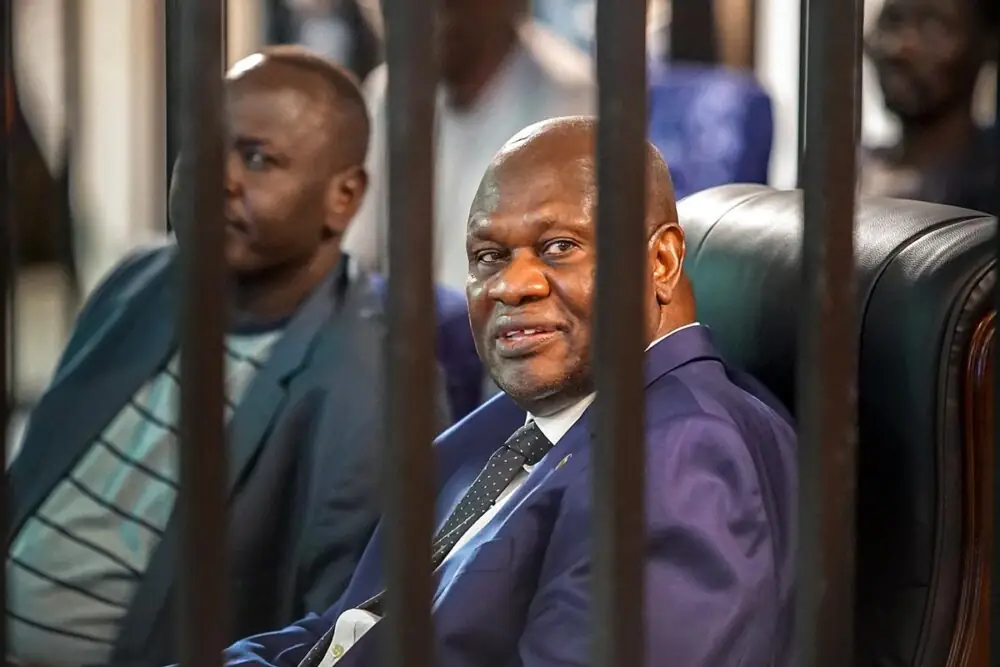

Riek Machar Teny in the prison cage during the hearing of his trial. |File Photo|.
Friday, 28 November 2025
The International Crisis Group expressed concerns over the ongoing trial of South Sudan’s First Vice President, Riek Machar Teny, and seven other co-accused, and warned that the move threatens the implementation of the fragile revitalised peace agreement.
In September, the South Sudanese government charged First Vice President and former rebel leader Riek Machar, along with seven of his key allies, with criminal offences including treason, murder, and crimes against humanity.
President Salva Kiir also suspended Machar, his perennial arch-rival, from his position as vice president and established a Special Court for National Crimes for the sole purpose of trying Machar alongside the other seven accused.
The trial – which formally began on 22 September – is now entering a critical phase. Prosecution witnesses have begun to testify, and the rapid pace of the proceedings suggests that a verdict may be reached soon. The outcome could convulse South Sudan’s political system.
The charges stem from a March uprising in the Nuer opposition hotbed of Nasir, a town in eastern Upper Nile state near the border with Ethiopia. Fighting erupted after Kiir announced plans to deploy Dinka and Shilluk militias loyal to him to Nasir.
Town leaders condemned the move as a provocation, while a local militia known as the White Army responded by overrunning a military base, killing Lieutenant General Majur Dak, a Dinka, amid an evacuation attempt by the UN.
The government accuses Machar of orchestrating this attack, and since March, it has mounted a steadily escalating crackdown. It arrested Machar’s top political and military allies in the capital Juba, including the oil minister and the deputy army chief, both Machar appointees.
Kiir’s administration launched airstrikes on Nuer villages and military positions of Machar’s Sudan People’s Liberation Movement-In Opposition (SPLM-IO) in the Upper Nile and Equatoria regions. In late March, the authorities put Machar under house arrest in Juba, allowing him no visitors or access to communication devices.
Machar’s trial sits at the heart of a systematic shakeup of Kiir’s regime that has brought political upheaval to South Sudan. Since October 2024, Kiir has staged a multi-phase campaign to purge other powerful figures from his regime, including top security officials, vice presidents, and the main leaders of the ruling party, according to the group.
Those dismissed included powerful intelligence chief Akol Koor and party deputy chairman and vice president James Wani Igga.
Until recently, the main beneficiary of these changes was political newcomer Benjamin Bol Mel, who was appointed as Kiir’s vice president and deputy party chairperson in apparent line for the succession.
But then, in November, Bol Mel was fired and placed under house arrest himself, also in dramatic fashion. In the aftermath of Bol Mel’s ouster, Kiir’s family appears to be wading directly into politics and possibly into competition for the presidency upon his departure.
Kiir’s daughter Adut, once allied with Bol Mel, played a critical role in his downfall and is now a key figure in the president’s office. Among these various shakeups, the prosecution of Machar could prove the deadliest for South Sudanese.
What is behind the prosecutions?
The rivalry between Kiir and Machar has played an outsize role in South Sudan’s politics and conflict. Kiir is from South Sudan’s largest ethnic group, the Dinka, while Machar is the most prominent politician from the Nuer, the second largest.
Both were among the early guerrilla commanders in the Sudan People’s Liberational Movement (SPLM), formed in 1983 to fight the government of Sudan, of which South Sudan was then a part. In 1991, however, Machar created a splinter movement, leading to years of internecine violence, largely along ethnic lines, in which the Sudanese government in Khartoum often supplied his forces with arms. Machar rejoined the main SPLM rebellion after a 2002 agreement that placed him third in the party hierarchy, below John Garang (the SPLM’s founder, also a Dinka) and Kiir.
This reconciliation paved the way for the landmark 2005 Comprehensive Peace Agreement between Khartoum and the SPLM, which in turn led to South Sudan’s secession in 2011. In a surprise turn of events, Garang died in a helicopter crash three weeks after taking office (and months after signing the accord), leaving Kiir as the new chairman and president of South Sudan, with Machar as his deputy.
Following independence, Machar challenged Kiir as party leader in 2013, giving rise to a power struggle that morphed into a five-year civil war. A 2015 peace deal collapsed less than a year later, when a tense meeting between Kiir and Machar ended in a firefight between their bodyguards. Kiir’s forces then chased Machar and his entourage into the Democratic Republic of Congo, where the UN evacuated them from Garamba National Park.
Machar’s next stop was in South Africa, where he lived as the civil war in South Sudan spread. Eventually, in 2018, Kiir and Machar agreed to a new peace deal under pressure from Uganda, which backed Kiir, and Sudan, which favoured Machar. Under the terms of that accord, Machar returned to South Sudan as Kiir’s vice president in 2020. Even so, the government has yet to honour the deal’s main provisions, including unifying the national army, adopting a new constitution and holding the country’s first elections.
More broadly, Kiir’s systemic purge of the top elite is a response to intense pressures on his regime. These include the collapse of oil revenues following the war in neighbouring Sudan, which halted the bulk of its oil exports, its main source of revenue, for more than a year. At the same time, competition among South Sudan’s elites over Kiir’s succession has simmered amid rumours that his health is failing. Seeing an existential threat, Kiir began in October 2024 to remove those potential successors, despite the risks these actions would pose to political stability and the country’s ailing economy.
What have the effects of Machar’s prosecution been so far?
Kiir’s purge is destabilising South Sudan on several fronts – in terms of security, governance and humanitarian conditions – and pushing the country closer to renewed conflict than at any point since the 2018 accord. The Machar trial has cast a shadow over Juba and put the country on edge: traffic in the capital halts during court sessions. The tensions heightened further upon Bol Mel’s dismissal. On the eve of his sacking, the city streets were nearly empty as residents braced for violent repercussions.
Paralysis in the government coincides with dire economic and security conditions. In response to the prosecution of its leader, Machar’s SPLM-IO declared the 2018 peace deal “abrogated” in September. Military action soon followed, with clashes between the army and SPLM-IO forces intensifying, particularly in Equatoria and Upper Nile. Machar’s group has also forged a new tactical alliance with other insurgent forces, above all in Equatoria, where Juba is located.
The security threats have exacerbated an already bleak humanitarian situation.
The security threats have exacerbated an already bleak humanitarian situation. An estimated 9.3 million people – nearly 70 per cent of the population – now require assistance, with 7.7 million facing acute food insecurity and 83,000 at risk of famine, according to the UN.
A worldwide squeeze on humanitarian aid funding means that many of these needs are going unmet. The World Food Programme, which faces a potential 40 per cent cut in its spending in 2025, has already suspended assistance for millions in East Africa and directly linked the funding gaps to the heightened danger of famine in South Sudan.
The loss of oil revenue has made matters even worse. Oil is now flowing, but at lower rates than before the cutoff, and the war in Sudan poses a continuing threat of further interruptions to South Sudan’s oil production. With security forces unpaid for months, attacks on the population by frustrated soldiers have increased, and confrontations between rival units are frequent. Insecurity is restricting the already irregular delivery of humanitarian aid and disrupting economic activity at the grassroots.
How might the trial end, and what might its effect be?
Machar and his fellow accused have slim chances of the court finding them innocent. While the constitution provides for an independent judiciary, in practice the country’s legal system faces profound challenges, including political interference and a lack of resources. These weaknesses are central to the defence’s claim that a fair trial is not possible.
Prosecutors have presented a detailed account of Machar’s supposedly premeditated plot, using digital communications and official testimony as evidence, with the aim of connecting him and the other defendants to the uprising in Nasir. They are making their arguments before a Special Court panel of three judges in Juba, behind a heavy security cordon, with the proceedings broadcast live on state television. Private media workers, civil society representatives and relatives of the accused, meanwhile, have been barred from attending the court sessions in person.
Defence lawyers argue that Machar and his allies have been gravely wronged. They say Machar and his co-defendants were not involved in the revolt, claiming that the Nasir clashes were triggered by a local dispute that spiralled out of control. Though the White Army often fought alongside Machar’s forces during the civil war, it has also often acted independently, complicating the prosecution’s effort to prove a direct command link between Machar and the Nasir incident. The defence team has also pointed out that, before the fighting in Nasir, Machar had asked for a meeting with Kiir to quell rising tensions between them, but the president ignored the request. The lawyers have gone on to argue that the prosecution’s evidence was illegally obtained and mishandled, challenging the admissibility and reliability of the key digital communications and testimony in court.
[Machar’s] lawyers insist that the authorities are pursuing a political vendetta masquerading as a criminal trial.
Lastly, Machar’s defence team has contested the legality of the trial itself, arguing that the Special Court hearing the case is unconstitutional, primarily because the 2018 peace deal mandates that alleged crimes against humanity be tried by an African Union-led hybrid court, not a South Sudanese tribunal appointed by the president.
The lawyers insist that the authorities are pursuing a political vendetta masquerading as a criminal trial; in any case, they say, the constitution grants Machar, as first vice president, immunity from prosecution. Nonetheless, the Special Court dismissed these objections in September, ruling that it had jurisdiction.
Should the trial proceed to its conclusion, a simple acquittal would seem unlikely. In similar high-profile treason cases – such as the 2014 trial of former SPLM Secretary-General Pagan Amum and the 2018 conviction of former SPLM-IO spokesman James Gatdet – the judiciary has rarely ruled against the state.
Legal analysts suggest that the most likely endgame is a conviction followed by a presidential pardon, a manoeuvre that would allow Kiir to brand Machar a criminal while appearing magnanimous himself. Alternatively, Kiir might use the threat of a guilty verdict to force Machar’s exit from the domestic political scene. In any event, exoneration by the court itself would seem improbable, given Kiir’s firm support for the prosecution.
Still, a conviction could backfire. Especially if it results in forced exile, it could well intensify the violent backlash from Machar’s allies. But many scenarios could play out.
Machar and his allies might seek to fight on militarily, but they would need more money if they were to wage anything more than a low-intensity insurgency. With Machar held incommunicado, his movement could also break apart, resulting in further fragmentation of South Sudan’s political and security landscape.
Are there any ways out of worsening conflict?
The downfall of Bol Mel has for now upended Kiir’s succession plan. Moreover, the prosecution of Machar is a high-stakes gambit that even many of his foes think is unwise and dangerous for the country.
Given that Machar was originally arrested as part of efforts to push aside rivals to Bol Mel, the subsequent fall of Kiir’s heir apparent could be an opportunity for the president to change course. Some speculate that Kiir could do so, blaming Bol Mel (who appeared to be personally overseeing the case against Machar) for the entire affair and seeking to turn the political page.
The uncertainty generated by Bol Mel’s fall from grace has already led Kiir to bring some purged officials back into the fold, including Wani Igga, Kiir’s long-time deputy and vice president.
Countries with close ties to South Sudan that want to avoid another violent breakdown in the country – particularly Uganda, Kenya, Ethiopia and South Africa – should try to persuade Kiir to seize this opportunity. They should push for an immediate suspension of the prosecutions along with direct negotiations with Machar over his future.
While many foreign countries are still urging Kiir to return to the roadmap in the 2018 peace deal, this option may not be realistic or even desirable, given the accord’s tattered state and South Sudan’s compound crises.
The most viable roadmap would be a wider political conversation, brokered by the African states above, on South Sudan’s political future. Given their previous efforts to bolster the 2018 peace deal and bring about political reconciliation in South Sudan, the Vatican, the Anglican church and other global religious institutions, such as Sant’Egidio, could also play a vital public or private role.
Dialogue in South Sudan must take into account today’s realities, whether the neutralisation of the old guard or the rise of new factions such as the one formed in October by former foreign minister Nhial Deng Nhial.
Negotiations are the only plausible way to prevent the country’s political fissures from widening. Without talks, the threat of a return to conflict will loom ever larger.