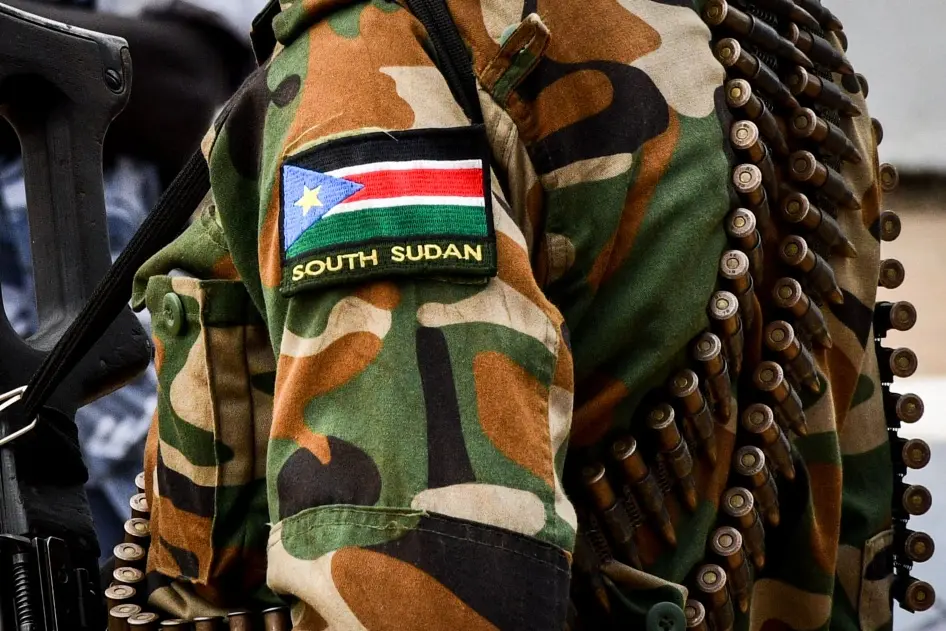

South Sudan People’s Defence Forces (SSPDF) soldiers. |File photo|.
Saturday, 24 January 2026
The Deputy Special Representative of the UN Secretary-General for Political Affairs, Graham Maitland, said the ceasefire violations have become more systemic, with direct military confrontations between armed forces aligned with the main parties occurring in eight of the ten states of South Sudan.
In a press statement, Maitland said the renewed conflict that started in December 2025 between the Sudan People’s Liberation Movement-In Opposition (SPLM-IO) and the South Sudan People’s Defense Forces (SSPDF) in Jonglei State has displaced more than 180 000 people, mostly women, children, and the elderly. In addition, hundreds have been subjected to abduction, while sexual violence has increased by 40% compared to 2024.
Maitland stated that efforts to amend national legislation without consensus and representation of all signatories to the revitalised peace agreement will likely exacerbate political polarization and the contestation over legitimacy, with consequences for security in the country.
He thanked the African Union Peace and Security Council for convening a meeting to evaluate the progress of the peace implementation and explore ways to address the contentious issues hampering the smooth implementation of the agreement.
He said this deterioration has been compounded by recent political developments, emphasising that since December, a negative trajectory of actions has emerged, ostensibly aimed at amending the peace framework established by the Revitalized Agreement, including delinking the elections from the constitution-making process and the census, risking the collapse of the peace agreement.
In recent weeks, the last remaining mainstream SPLM-IO ministers have been removed from the cabinet, and 11 SPLM-IO members of parliament have been removed from the national parliament as the detention of the First Vice President, Riek Machar Teny, and seven co-accused continues.
The humanitarian situation in South Sudan is expected to sharply deteriorate in 2026 due to escalating conflict, which will worsen the already dire situation at a time when humanitarian funding has been reduced by 40% while the number of people requiring assistance in South Sudan has risen from nine to 10 million.
“In this context, armed actors must remove access constraints and ensure the safety of humanitarian workers so assistance can urgently reach affected communities,” Maitland said.
“International partners have conveyed their concern that unilateral decisions taken in the current deteriorating context risk eroding confidence, particularly when collective civil society and diplomatic appeals seem not to be sufficiently taken into account,” he added.
The Revitalized Agreement remains the only viable framework for achieving stability in South Sudan. Its preservation requires renewed dialogue and meaningful compromise among the political class.
“Our support to the peace process must be contingent on an inclusive process and political will from the signatories to return to the Revitalized Agreement framework,” he stressed.
He appealed to the African Union Peace and Security Council to call on the parties to halt ongoing fighting and recommit to the Cessation of Hostilities Agreement; uphold their commitments under the Revitalized Agreement, including the power-sharing and transitional security arrangements, and engage in consensus-based decision-making.
He also called for inclusive, high-level dialogue under the framework of the Agreement to resolve the current impasse and agree on a clear and consensual path to ending the transition period; and he hopes that the upcoming Summit of African Union Heads of State will be an opportunity to consolidate continental peace efforts in South Sudan.
“Completing a peaceful democratic transition is a shared goal between South Sudan and the international community. But it is the South Sudanese themselves, and first and foremost the authorities, who must do the heavy lifting,” he concluded.